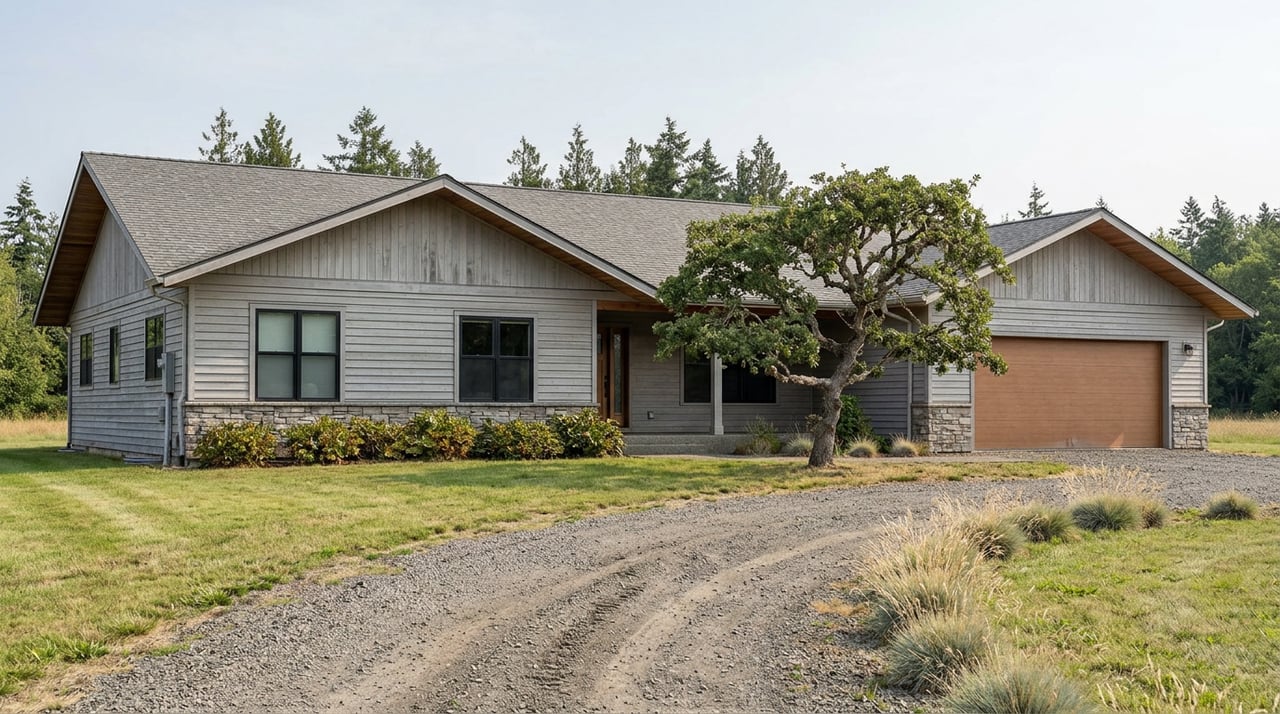
Bush Prairie Land Development in Tumwater Explained
August 20, 2026
August 20, 2026
Five acres east of Olympia Regional Airport still grow vegetables the way they have for generations. The Clark family runs a small community-supported farm there, on ground first settled in 1845 by George and Isabella Bush, whose homestead became the seed of what is now Tumwater. A 171-year-old butternut tree still stands on the property. Mark and Kathleen Clark placed the land under a permanent conservation easement with Capitol Land Trust, protecting both the farm and a healthy colony of Mazama pocket gophers that live beneath it.
That small transaction, five acres, one family, one easement, is a preview of something much larger playing out across Tumwater right now. If you are looking at vacant land, an acreage lot, or even a modest single-family parcel in the Bush Prairie area, the availability of buildable land may depend on whether federal habitat protections apply to the parcel.
The Olympia subspecies of the Mazama pocket gopher was listed as threatened under the Endangered Species Act in 2014. It lives almost entirely underground in well-drained, loosely packed prairie soil, the kind of open, short-grass terrain that once covered much of south Puget Sound before development, agriculture, and encroaching trees took over. The U.S. Fish and Wildlife Service estimates that roughly 95 percent of that historic prairie has already been converted to other uses. What's left is patchy, and much of what remains sits inside the city limits of Tumwater, concentrated in and around Bush Prairie.
The Washington Department of Fish and Wildlife puts the practical reality plainly: the species can coexist with some development, but high-density building on occupied ground tends to wipe out the local population entirely. That single fact is why the City of Tumwater's own planning materials describe significant parts of the city as having been removed from consideration for housing, employment, schools, and utilities. Not because the land was rezoned. Because gophers were found on it.
For a buyer comparing two similar-looking lots in Bush Prairie, this is an important factor to investigate beyond a listing description. One parcel may be entirely buildable. The one next to it may require a federal biological survey before a shovel goes in the ground.
Tumwater and the Port of Olympia have spent years trying to solve this with a joint Habitat Conservation Plan, a federal mechanism that lets a city set aside enough protected habitat in one place to offset development everywhere else. The city's own estimate for what that requires is stark: roughly 1,015 acres of mitigation land, at a cost north of $55 million spread over 30 years, just to keep permitting functional citywide.
In the meantime, smaller deals have been filling the gap piece by piece.
| Transaction | Scale | Cost | Status |
|---|---|---|---|
| Puget Western mitigation credits | 171 credits generated from 67.5 acres on 93rd Avenue turned into gopher habitat | Roughly $5 to $8 million for the 111 credits the city moved to purchase | Approved in February 2023, financed with an inter-fund loan from sewer utilities as an interim measure |
| Bush Prairie Farm conservation easement | 5 acres near the airport | Funded through Capitol Land Trust and USDA support, price not public | Permanently conserved |
| Proposed 300-acre conservation parcel | Largest contiguous undeveloped tract in the Olympia pocket gopher's range | Purchase price still being negotiated, boosted by a $1 million Angela J. Bowen Conservancy Foundation gift | Multi-party negotiation ongoing as of January 2026 |
| Joint City of Tumwater and Port of Olympia Habitat Conservation Plan | 1,015 acres needed citywide | More than $55 million over 30 years | Under U.S. Fish and Wildlife Service review, consultant contract just extended through 2027 |
Read top to bottom, that table tells you something worth sitting with. Back in 2023, the city calculated it needed roughly 1,000 mitigation credits to fully cover its own development footprint and had secured 111. The gap between where the program started and where it needs to land is not small, and it is being filled one negotiated parcel at a time rather than through the streamlined, citywide system the HCP is supposed to provide.
In its own legislative priorities materials, the city describes this joint plan as "near completion." Recent updates show the plan remains under review. On May 26, 2026, Port of Olympia Environmental Director Shawn Gilbertson walked the Tumwater City Council through where the plan stands with federal reviewers, a step the U.S. Fish and Wildlife Service takes before a project can even enter formal environmental review. A week later, on June 2, the council authorized a contract amendment adding $445,108 to environmental consulting firm ICF Environmental Inc.'s agreement, bringing the total to $954,108 and extending the work through 2027.
In a January 2026 ThurstonTalk report, Brad Medrud, Tumwater's Community Development Director, said:
"If the Bush Prairie Habitat Conservation Plan is not completed, individual property owners would be responsible for obtaining federal permits to develop under the Endangered Species Act and any conservation land created by that process would have less habitat value for the protected species because such land would be smaller in size and fragmented."
Until the citywide plan is complete, individual projects remain subject to the project-by-project federal permitting process. The city has to thread this while also meeting its obligations under the state's Growth Management Act, which requires Tumwater and its urban growth area to accommodate 15,000 more people, 9,000 more housing units, and 10,000 new jobs by 2045. The pressure to build and the legal obligation to protect habitat are running on the same clock, and neither is winning outright.
If a vacant or lightly developed parcel in Tumwater, particularly anything touching Bush Prairie or open prairie-type ground near the airport, is on your list, a few questions are worth resolving before you get past inspection contingencies:
None of these questions are deal breakers on their own. But they are the difference between a feasibility study that takes a few weeks and one that stretches into a multi-month federal review, and that difference belongs in your timeline and your offer price before it becomes a surprise during due diligence.
The pocket gopher gets the headlines, but The Jolt News reports that the joint Habitat Conservation Plan covers four species: the Olympia pocket gopher, the Oregon spotted frog, the streaked horned lark, and the Oregon vesper sparrow. Most of Tumwater's development friction traces back to the gopher specifically, since its habitat overlaps most directly with buildable prairie ground, but a thorough feasibility study on affected land should account for all four.
Does this affect homes that already exist, or only vacant land? Mostly the latter. The Bush Prairie Habitat Conservation Plan FAQs note that many projects within city limits will have no adverse impact on covered species and won't be touched by the HCP at all. It's projects that clear or disturb occupied habitat, new construction, subdivision, significant redevelopment, that trigger the process.
Is Bush Prairie the only part of Tumwater in range? It's the area most associated with this issue. The 300-acre parcel the city has been negotiating to buy sits in Bush Prairie and is described as the largest contiguous undeveloped tract in the Olympia gopher's range. But the species needs open, well-drained, non-wooded soil, so established, tree-covered neighborhoods like Tumwater Hill or the Deschutes River corridor generally fall outside that habitat profile. Open ground near the airport and remaining prairie remnants are where the question comes up most often.
Where do I actually check? For land under Thurston County jurisdiction, the county's Habitat Conservation Plan permitting page is the starting point. For land inside Tumwater city limits, the Community Development Department is the right first call, well before you're deep into a purchase contract.
Land like this rewards patience and a little translation. The paperwork is unusual, the timeline is not always predictable, and the story behind a single parcel often runs back through decades of prairie history most buyers never think to ask about. That is exactly the kind of due diligence Christina Keller walks clients through, whether the land in question is five acres or fifty. If you're weighing a piece of ground in Bush Prairie or anywhere else in Thurston County where the zoning map only tells part of the story, let's connect.
This article is general information, not legal, tax or financial advice. Consult a qualified professional about your situation.
Stay up to date on the latest real estate trends.
Christina Keller believes every client, property, and transaction is unique. Drawing from her background in hospitality, international sales, and business leadership, she provides attentive guidance, strategic negotiation, and personalized service designed to make every real estate experience smooth, successful, and rewarding.
CHRISTINA KELLER
[email protected]
360.951.2309
ADDRESS
2622 N PROCTOR ST
TACOMA, WA 98407