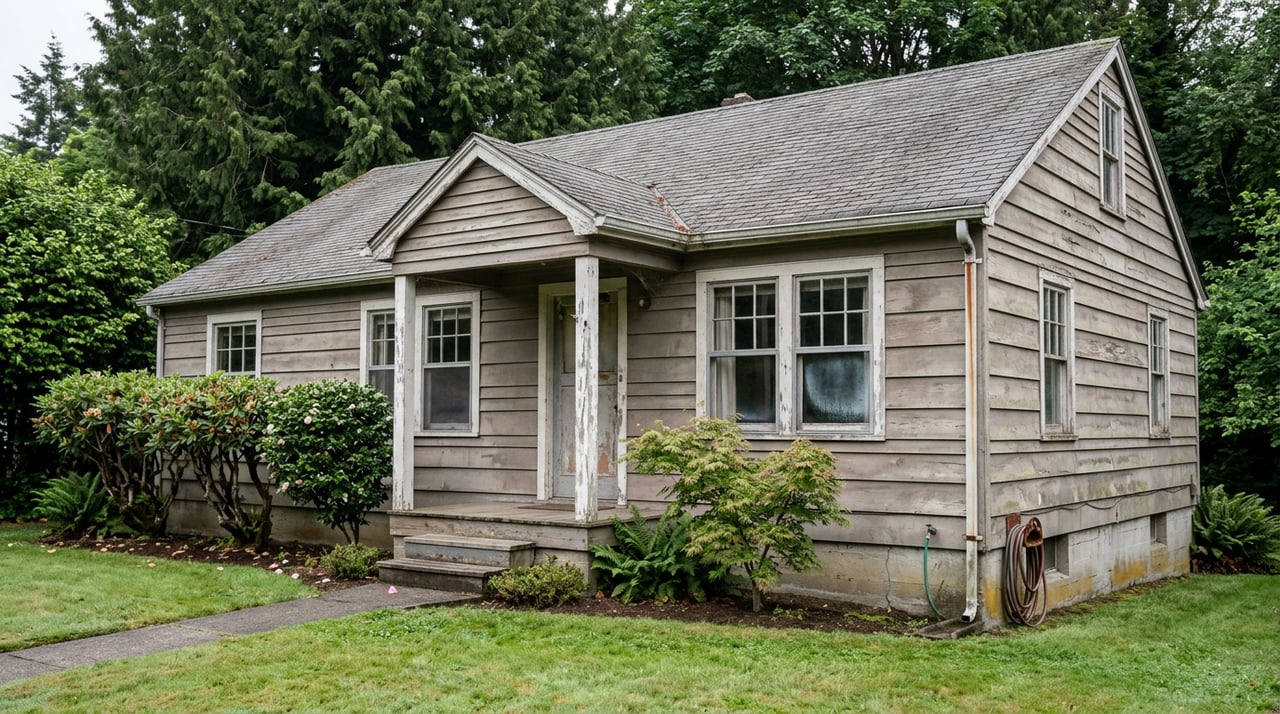
In Olympia's Older Homes, an Oil Tank Question Is Really a Paperwork Question
August 27, 2026
August 27, 2026
A house near downtown Olympia can pass every visible test. The roof is newer, the furnace runs on gas, the sewer scope comes back clean. Then the inspector notes an old fill pipe capped near the foundation, or a line item on the seller's disclosure that says "don't know" next to underground storage tank, and the whole transaction slows down while everyone tries to figure out what that means.
Here is what most buyers and sellers get wrong about that moment. They treat it as a question about the tank: is it there, is it leaking, how bad could it be. The tank matters, but in Thurston County the more consequential question is whether the work already done on that tank left a paper trail, and that answer depends less on the property than on which city hall it sits in.
Heating oil was the standard fuel for home furnaces across the Pacific Northwest from roughly the 1920s through the 1960s, before natural gas service expanded and made the switch easy. Olympia's own building history lines up with that window almost exactly. A residential survey submitted to the city documents that construction in several close-in neighborhoods peaked in 1947, with smaller secondary bumps in 1949 to 1950 and again in 1960. The Southwest Olympia survey area alone saw 38 homes built in 1947 and another 12 in 1960. Much of the South Capitol Neighborhood Historic District was already built out before 1939, with only 90 of its primary homes added afterward.
None of that means every house from that era has a buried tank. It means the odds are high enough that a home built or substantially occupied before natural gas became routine deserves a specific question, not a general assumption that "it's an old house, that's just how it is."
According to Titan Inspection Services, Washington's Seller Disclosure Statement, commonly called Form 17, asks directly about underground storage tanks in its environmental section.
Here is the detail that changes how this plays out depending on where the house sits. According to ActiveRain, most cities in Thurston County require a permit and an inspection when a heating oil tank is taken out of service, whether it's removed or closed in place. Lacey and Tenino are the exception. Neither city requires a permit for that work, which means there is often no municipal record to check even when the job was done correctly.
That gap matters at closing in a very specific way. Two houses can have identical tanks, decommissioned by the same contractor in the same year, using the same method. One sits in Olympia or Tumwater, where the permit creates a record a title company or buyer's agent can eventually track down. The other sits in Lacey, where the only proof that the work happened is whatever the property owner personally kept, an invoice, a contractor's letter, a photo. If that document was never saved, or was lost across two or three ownership changes, there is effectively nothing to point to. Thurston County Public Health maintains guidance on abandoned tanks for exactly this reason, since city permit records alone can't answer the question in every part of the county.
The reason this paperwork gap carries real weight is a piece of Washington case law that changed how sellers and their agents think about heating oil risk. In Grey v. Leach, a Washington Court of Appeals panel ruled on a dispute involving a house built in 1924. The sellers had owned it since 1966 and used oil heat until a 2004 remodel, when they decommissioned the tank and switched to gas. Three years later, the buyers discovered that a return line running beneath the basement slab had been slowly leaking oil since at least 1987, and possibly as far back as 1971. Cleanup cost the buyers close to $200,000, and they sued the previous owners to recover it.
The former owners argued they were innocent purchasers who never intended to cause any contamination. The court disagreed, holding that under Washington's Model Toxics Control Act, simply operating the heating system that caused a release is enough to create liability, regardless of intent or negligence. The court also ruled that a home heating oil leak doesn't qualify for the law's domestic use exclusion. Under this framework, liability for cleanup follows the property, and there is no statute of limitations that closes the door on it.
That combination, strict liability plus no time limit, is exactly why a missing decommissioning record matters more in Thurston County than it might elsewhere. If a buyer in Lacey later discovers a leak from a tank the previous owner closed out without a permit or a saved invoice, there is no clean paper trail establishing when the work happened or whether it was done to any particular standard. The physical work might have been fine. The absence of documentation is what turns a routine question into a slower, more expensive one.
| Scope of work | Typical cost range |
|---|---|
| Closure in place (tank cleaned, filled with inert material, capped) | roughly $700 to $3,000 |
| Full excavation and removal | roughly $593 to $2,155, averaging around $1,357 |
| Removal plus a documented risk assessment | around $5,000 |
| Contamination requiring soil remediation | can run well into six figures |
The gap between those first three rows and the last one is the entire reason to sort this out before listing rather than during a pending sale. Washington's building and fire codes, following the International Fire Code, generally require that a heating oil tank out of service for a year or more be either removed or properly closed in place. Doing that work, and keeping the documentation regardless of whether your city requires a permit for it, is what turns an underground tank from an open question into a closed one.
A tank that was handled correctly but never documented reads, at closing, almost exactly like one that was never handled at all.
Washington's Pollution Liability Insurance Agency completed a transition in mid-2025 away from its old heating oil insurance model and into a loan and grant program instead. Under the current Heating Oil Loan and Grant Program, qualifying tank owners can receive up to $75,000 total, including up to $60,000 specifically for cleanup costs, with loan funds available for tank removal, infrastructure upgrades, or replacement heating systems. The program does not require enrollment years in advance. Owners can wait and apply once they're ready to act.
Applications open twice a year, in spring and fall, with each window running about 45 days. This year's spring cycle closed in mid-June, so anyone thinking about this now is looking at the next scheduled fall opening rather than a window that's currently active. Anyone sitting on an old oil tank in an older Olympia-area home should treat this less like emergency funding and more like a planning tool, worth applying for well before a listing goes live rather than after a buyer's inspection turns up a surprise.
If a home already has a gas furnace or a heat pump, does that mean there's no tank to worry about? Not necessarily. Plenty of homes converted to a new fuel source decades ago and simply left the old tank in the ground, sometimes with the fill pipe capped and buried, sometimes still faintly visible.
If the seller says the tank was decommissioned, is that the end of it? It's a good start, but ask for the document that proves it. In parts of Thurston County where no permit was required, a verbal assurance and a real record are not the same thing.
Can a buyer walk away from an accepted offer if a tank issue turns up during inspection? That depends on how the purchase and sale agreement is written and what contingencies remain in place at the time. This is a conversation for your agent and, where the numbers are significant, a real estate attorney, rather than something to guess at mid-transaction.
If you're weighing a sale or a purchase involving an older Olympia-area home and want a clear read on what a tank question might mean for your specific timeline, Christina Keller is glad to walk through it with you before it becomes a surprise. Let's Connect.
This article is general information, not legal, tax or financial advice. Consult a qualified professional about your situation.
Stay up to date on the latest real estate trends.






Christina Keller believes every client, property, and transaction is unique. Drawing from her background in hospitality, international sales, and business leadership, she provides attentive guidance, strategic negotiation, and personalized service designed to make every real estate experience smooth, successful, and rewarding.

CHRISTINA KELLER
[email protected]
360.951.2309
ADDRESS
2622 N PROCTOR ST
TACOMA, WA 98407